If you have been eyeing a duplex or triplex in Randolph, you are probably asking the right question: does a small multi-family here actually pencil out? The short answer is that it can, but only if you buy with a clear plan, realistic rent assumptions, and a close eye on condition and carrying costs. Whether you want to house hack, add a rental property, or compare a two-family purchase with other options, this guide will help you understand what matters most in Randolph. Let’s dive in.
Why Randolph draws small investors
Randolph offers a useful mix for buyers who want to stay near Greater Boston without jumping straight into a large apartment building. It is a relatively tight small-suburban market, with 35,114 residents and 12,632 households, and multifamily housing makes up a smaller share of the local housing stock than single-family homes. In practical terms, that means duplexes and triplexes can be harder to find and good opportunities may not sit for long.
The town also has a meaningful renter base. Census data shows a 2019-2023 median gross rent of $2,049, while current asking-rent data from Zillow shows higher market-facing numbers depending on unit size and property type. That gap is not unusual because those sources measure different things, but together they suggest you should underwrite with both long-range context and current market reality in mind.
What counts as small multi-family in Randolph
Before you run numbers, it helps to know how Randolph treats these properties locally. Under the town zoning code, a two-family is a building with two dwelling units, while a multifamily building has three or more dwelling units. Buyers often use words like duplex, triplex, and multifamily loosely, but the local code draws a clear line.
That distinction matters when you are evaluating use, financing, and future plans. Randolph’s zoning code lists separate use entries for two-family dwellings and multifamily dwellings, so you should verify the district-specific permitted use before assuming a property can be operated the way you want. A building’s layout, listing description, and past use are not enough by themselves.
Randolph price ranges to expect
One of the first surprises for buyers is how wide the pricing range can be for small multi-family property in Randolph. Recent examples point to a rough band from the mid-$400,000s for older or less improved stock up to the high-$900,000s for stronger or more renovated properties. That spread reflects age, location, updates, unit mix, utility setup, and overall condition.
Examples from recent market activity show that clearly. A 2025 listing at 591 N Main St was priced at $449,000, while 153 West St sold for $780,000 in April 2026 and was described as a two-family with separate utilities. Other examples include 37 A&B Clark St at $965,000 and a current duplex or triplex listing at 19 Clark St for $975,000.
Rent benchmarks for quick screening
If you are screening a deal fast, current asking rents can give you a starting point. Zillow’s Randolph rental market page, updated May 22, 2026, showed an average rent of $2,765 across all bedrooms and property types, with average asking rents of $2,578 for a 2-bedroom and $3,500 for a 3-bedroom. It also showed 33 active rentals and labeled the market as cool.
Those numbers are most useful as a first-pass rent screen, not as a guarantee. Actual rents depend on condition, location, layout, utility responsibility, parking, and how your unit compares with current competition. Still, they give you a simple way to test whether a listing deserves a deeper look.
Quick gross rent examples
Using Randolph’s current average asking rents:
- Two 2-bedroom units: about $5,156 per month or $61,872 per year
- Three 2-bedroom units: about $7,734 per month or $92,808 per year
- Two 3-bedroom units: about $7,000 per month or $84,000 per year
- Three 3-bedroom units: about $10,500 per month or $126,000 per year
These are gross numbers only. They do not account for vacancy, taxes, insurance, maintenance, reserves, management, or financing.
How to think about yield
A lot of buyers stop at rent and price, but that is only the first layer. Based on the asking-rent examples above, a $780,000 two-family could screen at roughly a 7.9% gross yield if both units rented near Randolph’s average 2-bedroom rent. A $965,000 three-unit could screen at roughly 9.6% gross yield if all three units rented near that same average 2-bedroom level.
That does not mean the property is automatically a good investment. Gross yield is just a screening tool. It helps you decide whether to spend more time on a property, but it is not the same thing as cash flow.
Randolph carrying costs matter
In Randolph, carrying costs deserve close attention. The town’s 2025 residential tax rate was $11.61 per $1,000 of assessed value, which can have a meaningful impact on your monthly numbers. If you are already stretching on purchase price, taxes alone can change whether a deal feels comfortable.
You also need room in your budget for insurance, repairs, and reserves, especially because much of the available small multi-family inventory appears to be older low-rise housing. Many buyers focus heavily on rent potential and then get surprised by mechanical updates, deferred maintenance, or turnover costs. A deal that looks strong on paper can tighten up quickly if you underestimate ownership costs.
Expect older housing stock
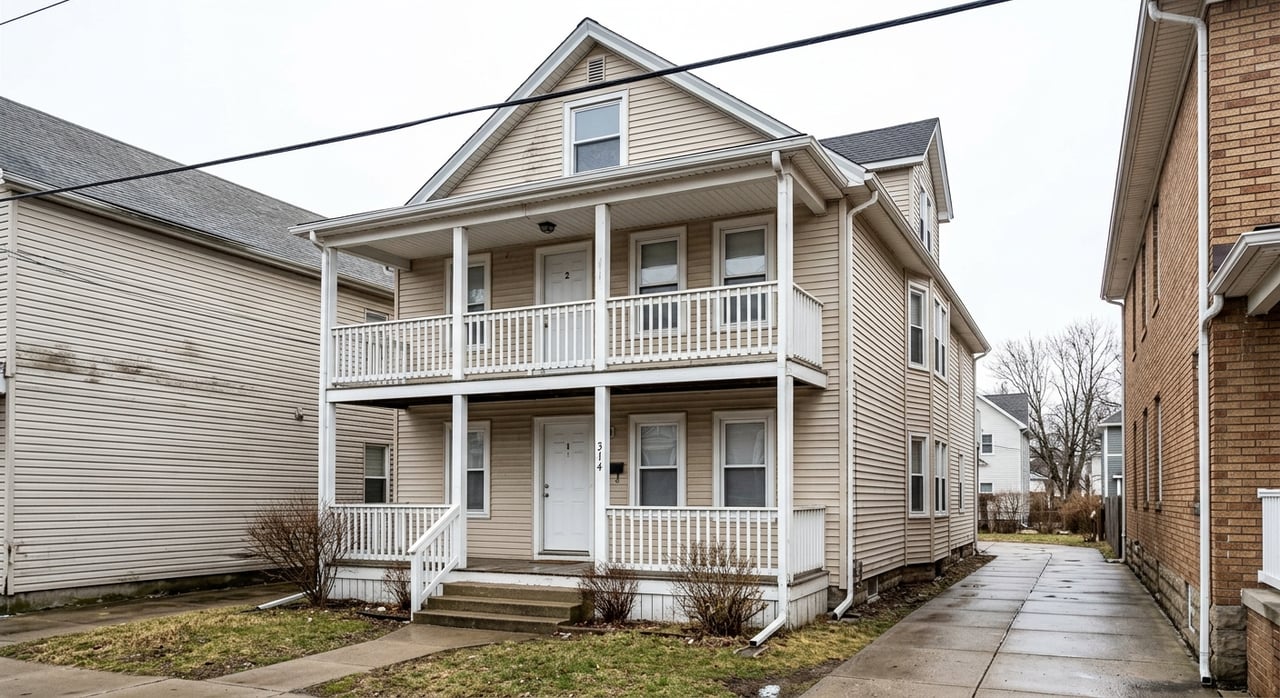
Recent Randolph small multi-family examples suggest you should expect older buildings with varied renovation histories. Market examples include a late-1800s wood-frame two-family at 153 West St, a 1962 multifamily at 37 A&B Clark St, and a 1970 duplex-style two-family at 105/107 Highland Ave. That kind of spread creates both opportunity and risk.
Older stock can offer larger layouts, separate systems, and attractive value compared with newer construction. At the same time, condition can vary widely from one property to the next. As you evaluate a building, pay close attention to heating systems, electric service, water and sewer setup, windows, roof condition, and whether utilities are separately metered.
Financing options for owner-occupants
For many buyers, the easiest path into small multi-family investing is owner-occupancy. HUD states that FHA single-family programs can be used for 1- to 4-unit owner-occupied principal residences, with down payments as low as 3.5%. That can make a house-hack strategy more accessible if you plan to live in one unit and rent the others.
VA-backed purchase loans can also be used for up to 4-unit properties, and the VA states that no down payment is required as long as the sales price does not exceed the appraised value. Fannie Mae also allows 2- to 4-unit principal residences. The key point is that owner-occupied financing often creates more options than a pure investor loan scenario.
How lenders may view your rent
Even when financing allows for rental income, lenders do not usually count every dollar of projected rent at full value. Fannie Mae instructs lenders to count rental income at 75% of gross monthly rent when lease agreements or market rents are used. That is a helpful rule of thumb for your own underwriting too.
In simple terms, start with gross rent, then apply a haircut for vacancy or collection risk, and then subtract expenses. That approach is especially useful in a market where Zillow showed only 33 active rentals at the time of the report. Limited inventory can help support rents, but you should still model lease-up time and real operating costs rather than assuming every month is fully occupied.
Duplex vs. single-family with ADU
Some buyers compare a two-family purchase with a single-family home plus an accessory dwelling unit. Randolph does allow accessory units, which can be internal, attached, or detached. The town’s guidance says the size limit is the smaller of 50% of the main home or 900 square feet.
That said, an ADU is not the same thing as buying a true two-family or three-family property. Randolph also states that short-term rentals are not allowed under its ADU guidance. If your goal is straightforward long-term rental income from a clearly defined multi-unit layout, a legal two-family or three-unit building may be simpler to evaluate than a property where you would need to compare the main house and accessory unit setup.
What makes a Randolph deal worth pursuing
In this market, the best small multi-family opportunities usually share a few traits. The building already has a functional two- or three-unit layout, current or projected rents are close to market levels, and the financing structure fits your plan. If one of those three pieces is weak, the deal often becomes much harder to justify.
As you review a listing, focus on the basics first:
- Is the property clearly configured as a legal two-family or multifamily use?
- Are the units a size and layout that fit local rent demand?
- Are utilities separate, or will landlord-paid utilities cut into returns?
- Does the condition support your timeline and budget?
- Do the taxes and likely insurance costs still work with realistic rent?
- If you are owner-occupying, does the financing structure improve the numbers enough?
Why patience matters in Randolph
Randolph is not a market flooded with small multi-family inventory. Because multifamily represents a minority share of the housing stock, buyers often need to be patient and selective. The goal is not just to buy a property with multiple units. The goal is to buy one that works for your budget, your financing, and your long-term plan.
That is where local guidance can make a real difference. A property may look appealing online, but details like zoning classification, utility setup, rental positioning, and renovation level often determine whether it is truly a good opportunity. When you have a clear underwriting process and local market context, you can move faster and with more confidence when the right building appears.
If you are thinking about buying a duplex, triplex, or other small investment property in Randolph, Kristen can help you sort through the numbers, compare options, and evaluate what fits your goals. Reach out to Kristen Meleedy for experienced, high-touch guidance on Randolph real estate.
FAQs
What is considered a small multi-family property in Randolph, MA?
- In Randolph zoning, a two-family has two dwelling units, while a multifamily building has three or more dwelling units.
What are Randolph, MA rent benchmarks for a duplex or triplex?
- Current asking-rent data cited in the report shows average rents around $2,578 for a 2-bedroom unit and $3,500 for a 3-bedroom unit, which can be used for a first-pass screening.
What price range should you expect for small multi-family properties in Randolph, MA?
- Recent examples suggest a broad range from the mid-$400,000s for older or less improved properties to the high-$900,000s for stronger or more renovated buildings.
Can you use owner-occupied financing for a Randolph, MA multi-family home?
- Yes. The report notes that FHA, VA, and Fannie Mae programs can apply to certain 1- to 4-unit owner-occupied properties, depending on borrower and lender requirements.
How should you underwrite rental income on a Randolph, MA small multi-family?
- A practical starting point is to begin with gross rent, apply a vacancy or income haircut, and then subtract taxes, insurance, maintenance, reserves, and financing costs.
Are ADUs an alternative to buying a duplex in Randolph, MA?
- They can be for some buyers, since Randolph allows internal, attached, and detached ADUs within stated size limits, but they are different from buying a legal two-family or three-unit property and short-term rentals are not allowed under the town’s ADU guidance.